



Tips to Comeback Your Strongest if You’re Navigating Injury, Illness, Surgery, Chronic Illness and Pain, etc.
2025 has been a whirlwind of a year for me when it comes to running: in October of 2024 I developed inappropriate sinus tachycardia that made walking by myself, let alone running, feel impossible. I was lucky if I could walk 2 steps, let alone run 2 miles because any time I would stand up from sitting or laying down, I would pass out and have multiple seizures at a time, multiple times a day. It took 3 months of testing: 2 weeks with a Zio patch on my chest that I had to push a button to note triggers and symptoms, a stress test that my heart rate got so high that I collapsed and had 2 seizures waking up in the back of an ambulance, and an electrocardiogram that all led to my cardiologist telling me there was nothing more she could do for me and that I needed to see an electrophysiologist. Because of my electrophysiologist, I was diagnosed with inappropriate sinus tachycardia, had surgery within a week to implant a heart rate monitor in my chest that operates like a Zio patch where I carry around a button to alert Medtronic of any symptoms, and she prescribed me a medication to bring my heart rate down. With this specific diagnosis, it’s a type of dysautonomia where doctors don’t necessarily know what’s causing my spikes in heart rates (hence why inappropriate is in the name), but they could see throughout my stress test, wearing a Zio patch for 2 weeks, and my electrocardiogram that my heart rate would rise anytime I would stand up or do any type of activity (walking, running, cycling, swimming, etc.), and it would significantly fall due to my heart not pumping enough oxygen into my body after having seizures.
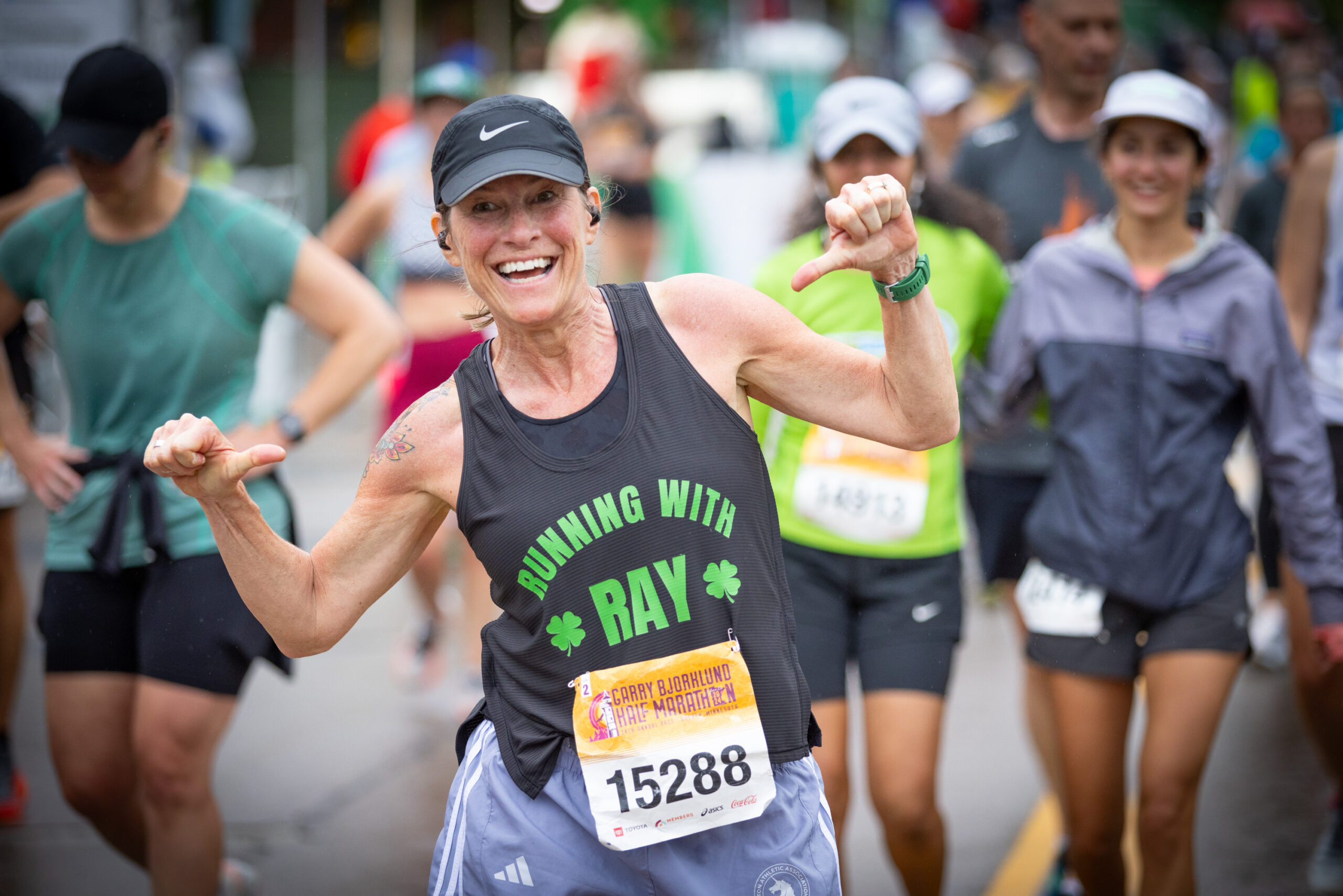
But as I’m writing this blog, even after going through all of this, that wasn’t the toughest thing that I went through all year. Right now, I’m currently recovering from having a full hysterectomy and laparoscopy at the young age of 33 due to having many polyps, non cancerous leiomyoma (fibroids) in my uterus, and endometriosis in my pelvis that caused me so much chronic pain that I had to significantly cut back on running in the year of 2025. But I didn’t know I had any of this until I had my first surgery to try and alleviate the pain immediately after finishing the 2025 Garry Bjorklund half marathon; but in all actuality, the procedure that confirmed my polyps and fibroids had made things exponentially worse. I could barely stand let alone walk on my worst days, and it seemed like I was having a lot more bad days than good. I still suspected I had endometriosis, so I kept advocating for myself! It wasn’t until months later in September that I got a 3 month dose of Lupron, went through some of the worst pain I’ve ever been through in my entire life after getting the shot, struggling with sensory issues because of my autism after going through faux menopause as a side effect of the drug, and getting a second opinion did I finally get the ability to have a full hysterectomy and laparoscopy; and it was through that procedure that my doctors were finally able to confirm I have endometriosis. (To read more about endometriosis, I’ve attached a link to Mayo Clinic here.
Now as I’m writing this, I’m at square one of the comeback journey: at the metaphoric red light, in the thick of the FOMO, wishing I was out there running like everyone else enjoying the winter wonderland, doing what I can until I get my green light. Having surgery, falling ill, and/or having seasons end in devastating fashions due to injury and or chronic illness/pain is hard to fathom because of the passion for running we all have that brings so many of us to the start line! It’s that passion that no matter how many times we’ve been injured or what the prognosis is from our doctors that keeps us patient, determined, and resilient to do what is necessary to make our comeback stories a triumphant one when it doesn’t feel like it in the moment as we’re in the struggle. If I’ve learned anything from weathering the injuries that I have, and especially this past year, whether from my own running journey or coaching runners who have had their seasons end through devastating injuries, here’s what I want you to know if you’re also in the struggle alongside me looking to make this comeback the best one you can:
- You are not a failure if you are sick, dealing with chronic pain, or are injured! Your body is sending you a cue that you need to slow down or stop altogether, and that doesn’t mean you failed in any way! It does mean though, the sooner you listen to your body with radical acceptance using a non judgmental stance towards yourself and your body, the sooner you can get back to doing what you love!
- Take things SLOW and again, listen to your body; even when you’re feeling good. Especially for those coming back from fractures or surgery’s like I am, it’s better to err on the side of caution and not rush into coming back to running. Start with run/walking intervals to start building where you’re walking more than running until you build to a point where running feels good again. The more patient you are, the more likely you are to not get injured again.
- This journey is not going to be easy! There are going to be days where you feel like you want to give up, you don’t understand the point, and those days are where you need to cling to why you’re doing this. Why getting to the start and crossing the finish line means something to you. Because when you set a goal and can emotionally attach yourself to why the outcome matters, you’re more likely to stick to a routine and follow through with what is needed to come back to running.
- Set SMART and ABCD goals during your training for your race day!
SMART is an acronym for Specific, Measurable, Attainable and Adjust as needed, Relevant (but I like to use the R as Resources needed as Reasons why your goal matters), and Timeline. This looks like:{Specific) I want to break 1:50 in the half marathon. I will measure my progress by building my training around my half being my A goal race and scheduling races and time trials around this race (2 mile time trial, Hot Dash 5k, Get in Gear Half, Eau Claire Half for the half and half challenge, Women Run the Cities 10k, Brian Kraft 5k) to measure my results to see how on track I am for my goal, adjust the goal as needed depending on race results and be realistic about what is attainable on race day, resources needed: shoes, running clothes for the winter, gloves, fuel (both on run and groceries for nutrition outside of running), fitness tracker, etc), and the timeline will take place after I have fully recovered from my hysterectomy.
ABCD goals are race day specific goals to have in mind based on how well your training went and also depends on uncontrollable factors like the weather: A goal is if you’re having your best day and had a really good training block, the goal here is your ultimate goal you originally set: sub 1:50, B goal is if you’re not having your best day, but it’s still a good day and your training went well; a goal below your A goal: sub 1:55, C goal is if you’re having an okay day and can still push; could also not have had a good training block or there are uncontrollable factors contributing to not racing your best; goal below B goal: sub 2, D goal is always to finish the race if it’s the worst day, because at the end of the day, finishing the race is ultimately what we’re training to do! - DNSing (did not start) is better than having a medical emergency on the course if something feels off. You could do everything right in your training and still get sick a couple of days before the race, or have the weather blow up your plans because there are things that we cannot control as we approach the start. If this happens, there is absolutely nothing to be ashamed of, and the journey to get to the start is just as much to be celebrated as the finish line feeling! Don’t be discouraged if you have to take a DNS, this doesn’t take away from the work you put in!
- Fitness is a privilege that many don’t have access to. Whether it’s due to cost, or spaces not being inclusive for all races, all genders, all sexual identities, all disabilities, all religions, etc. there are a multitude of reasons why someone may not be able to participate in fitness, making fitness inaccessible for a lot of folks. For many of us with injuries, recovering from surgery, etc, the inaccessibility to do what we love is temporary; but for others who face systemic barriers it can be inaccessible for many people. It can be hard to remember that this isn’t the end of the journey when we’re in the thick of not being able to run again, and a reminder that we as individuals can and do make a difference when it comes to making our sport inclusive for everyone!
- Last, to reframe the ways we view the mundane as a whole. Our habits aren’t things we HAVE to do necessarily, but things we GET to and WANT to do! When we’re healthy and able to run, it’s hard to remember that when we’re in the middle of a really hard long run, we’re in the pain cave, and we want nothing more than for it to be done and over with that we love this! We willingly signed up for this! But something that we can focus on when we’re not able to run is that our mundane may not be the same as our running routine, but these habits that we form and get to do now will lead to stronger running when we can return! Depending on what your doctor allows, you can gently walk like I am as I’m writing this on the treadmill recovering from a full hysterectomy, or if you’re not able to walk, you can work on mobility, cross train, or strength train depending on your restrictions.
I know we runners who are injured, recovering from illnesses, surgery’s, and especially for disabled runners like me who struggle with chronic illnesses can feel really isolated, left out, and alone in this journey of the comeback. Because a lot of times, the triumph itself is what is most viewed; not the many, many, MANY days of struggling, grinding, days of disappointment, days you don’t want to show up, days you want to give up because your body isn’t cooperating, and still doing it anyways. But I assure you, you’re not alone! I’m right here along with you recovering too, and we’re going to try to come back the strongest we can one day at a time, one step at a time to race our best for Grandma’s 50th! We’ve got this! 🩷
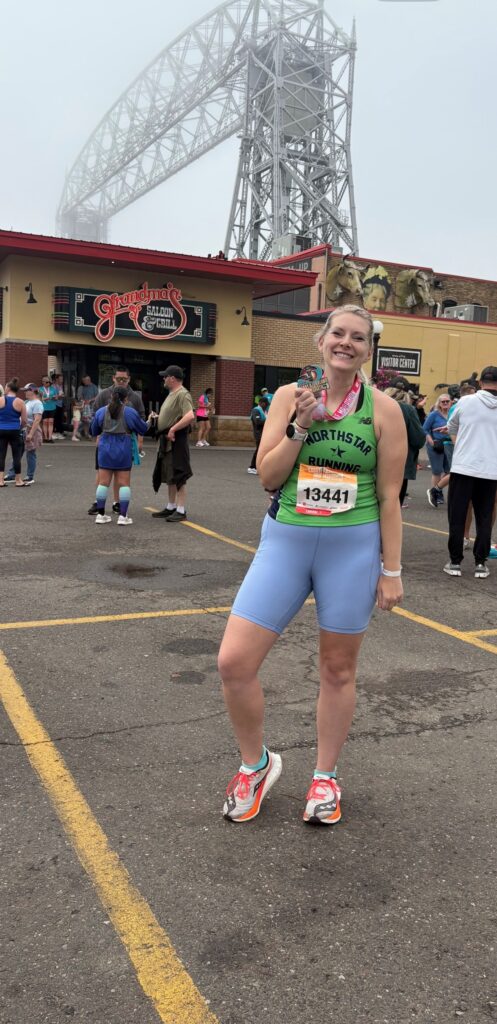
Ashley Daniels
Follow Her on: Instagram, Tiktok
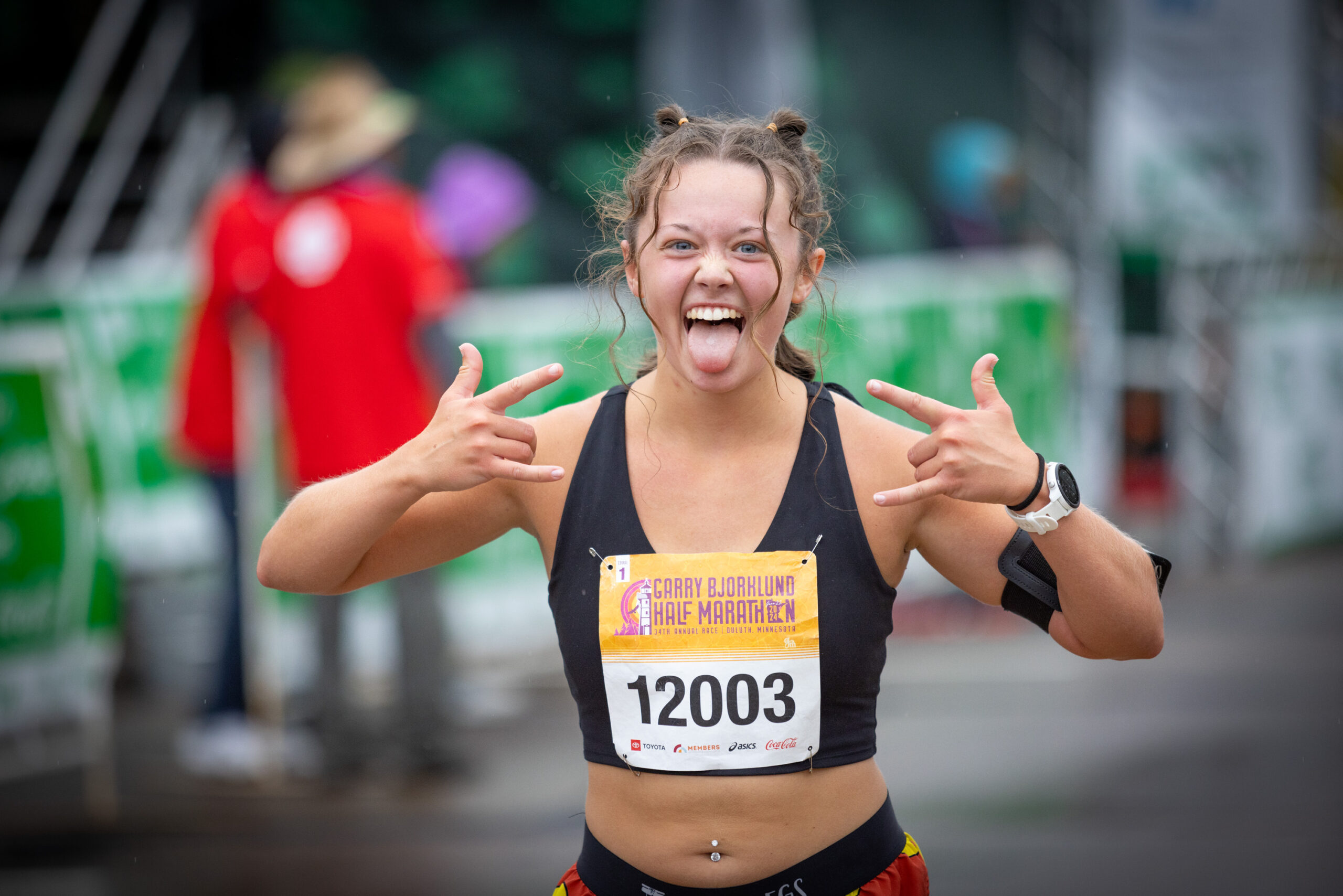
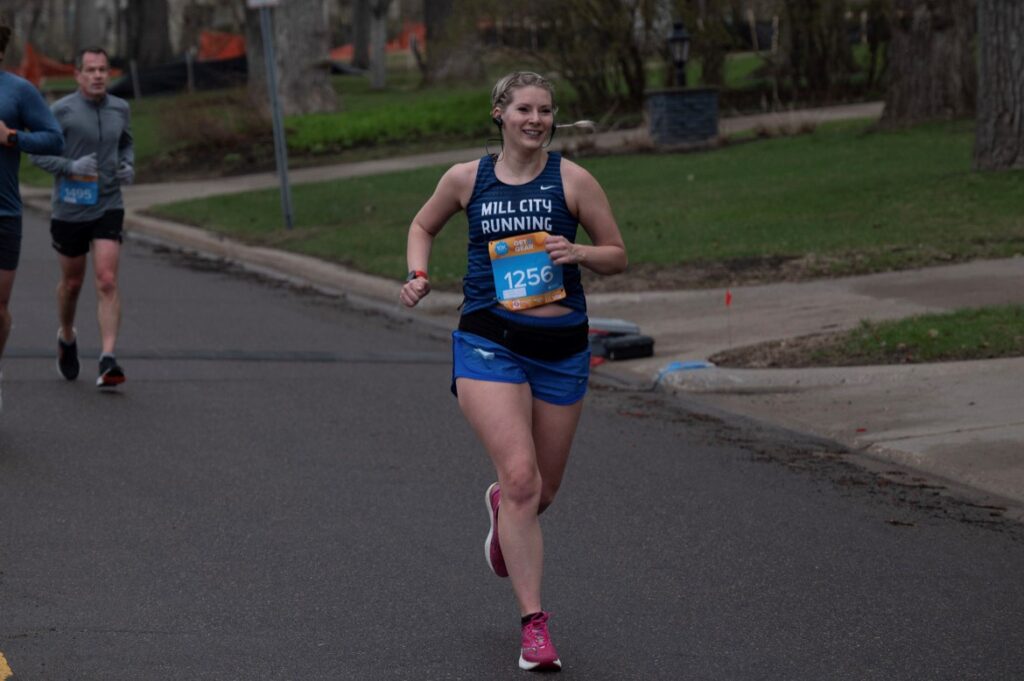
Favorite Grandma’s Marathon Memory: I have so many! But my most recent favorite was pacing one of my teammates to her first sub 2 half marathon and her PR at Garry Bjorklund Half in 2024! I ran into her on the busses and was really excited because we ran similar paces. Every mile we ran together, I looked forward to the fist bump until I could tell she was gaining speed at mile 8, and I was slowing down because I had run the 5k the day before. So I coached her through every obstacle she would face, deceptive hills that are worse than Lemon Drop to be wary of, and she took off. She ran well below 2 hours at 1:56 and ran her PR! As for me, I ran 2 hours on the nose that day, and to this day, I still don’t know how it happened!
Quote that guides, inspires, or embodies your training, racing, or life: This past year since being diagnosed with inappropriate sinus tachycardia, my mantra has had to be to “take things one day at a time”. Because there was a stretch of time that running wasn’t a guarantee for me. There were days that I couldn’t walk by myself without assistance from my walking mobility aid, because my heart rate would get really high walking around that I would pass out and have multiple seizures a day. The days I couldn’t run or do any exercise added up, and I lost a lot of strength, which also took a toll on my mental health. There was a genuine point where I did not think I was going to survive until I started to slow down, radically accept that my body was at a new square one, and to take things one day at a time. Now, I don’t take any run for granted, I think about that version of me often and how proud she would be if she could see me today, and I’m thankful that I still get to run races!
Song that must be on your running playlist: I am a huge fan of rock music that has pump up lyrics, so I listen to Heart vs. Mind by I Prevail, Hit Like a Girl by Meet Me @ The Altar, Power by The Score, and Can’t Stop Me Now by Oh the Larceny. I also listen to a LOT of wrestler entrance themes as pump up songs! My top songs are: Battle Cry (Kenny Omega), Elevated (Will Ospreay), and Prototheme (Kyle Fletcher)
2026 running goal: Now that I know running is safe for me, and I’m healthy, 2026 is going to be dedicated to working towards becoming the strongest version of myself! I want to show up to the start ready to shatter my post IST diagnosis PR, and I want to see how close I can get to my pre IST PRs!